Showing posts with label Wisdom from the Fathers. Show all posts

24 April 2011

Easter Homily - St. John Chrysostom

St. John Chrysostom lived and preached in the 4th century. He is considered one of the greatest preachers in the history of the Christian Church. His Easter Homily is well known and has been used for many centuries to proclaim the great Good News of our Lord’s Resurrection from the grave.

Is there anyone who is a devout lover of God?
Let them enjoy this beautiful bright festival!
Is there anyone who is a grateful servant?
Let them rejoice and enter into the joy of their Lord!

Are there any weary with fasting?
Let them now receive their wages!
If any have toiled from the first hour,
let them receive their due reward;
If any have come after the third hour,
let him with gratitude join in the Feast!
And he that arrived after the sixth hour,
let him not doubt; for he too shall sustain no loss.
And if any delayed until the ninth hour,
let him not hesitate; but let him come too.
And he who arrived only at the eleventh hour,
let him not be afraid by reason of his delay.

For the Lord is gracious and receives the last even as the first.
He gives rest to him that comes at the eleventh hour,
as well as to him that toiled from the first.
To this one He gives, and upon another He bestows.
He accepts the works as He greets the endeavor.
The deed He honors and the intention He commends.

Let us all enter into the joy of the Lord!
First and last alike receive your reward;
rich and poor, rejoice together!
Sober and slothful, celebrate the day!

You that have kept the fast, and you that have not,
rejoice today for the Table is richly laden!
Feast royally on it, the calf is a fatted one.
Let no one go away hungry. Partake, all, of the cup of faith.
Enjoy all the riches of His goodness!

Let no one grieve at his poverty,
for the universal kingdom has been revealed.
Let no one mourn that he has fallen again and again;
for forgiveness has risen from the grave.
Let no one fear death, for the Death of our Savior has set us free.
He has destroyed it by enduring it.

He destroyed Hades when He descended into it.
He put it into an uproar even as it tasted of His flesh.
Isaiah foretold this when he said,
"You, O Hell, have been troubled by encountering Him below."

Hell was in an uproar because it was done away with.
It was in an uproar because it is mocked.
It was in an uproar, for it is destroyed.
It is in an uproar, for it is annihilated.
It is in an uproar, for it is now made captive.
Hell took a body, and discovered God.
It took earth, and encountered Heaven.
It took what it saw, and was overcome by what it did not see.
O death, where is thy sting?
O Hades, where is thy victory?

Christ is Risen, and you, o death, are annihilated!
Christ is Risen, and the evil ones are cast down!
Christ is Risen, and the angels rejoice!
Christ is Risen, and life is liberated!
Christ is Risen, and the tomb is emptied of its dead;
for Christ having risen from the dead,
is become the first-fruits of those who have fallen asleep.

To Him be Glory and Power forever and ever. Amen!

21 April 2011

Holy Thursday's Joy!

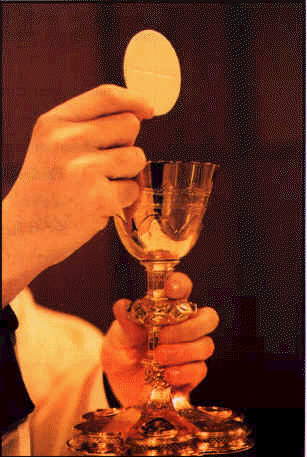
The happy commemoration of today's feast with its immense concourse of people invites us to prolong fervently our praises of the Most Holy Body of Christ. What could be sweeter, what more pleasing to the heart of the faithful than to exalt the abyss of his divine charity, and to glorify the overflowing torrent of his love! At the table of the new grace the hand of the priest distributes ceaselessly his Flesh as food and his precious Blood as drink, to those who are his children and heirs of the kingdom promised by God to those who love him.

O endless Emanation of the goodness of God and of his immense love for us, admirable and worthy of all praise! In this sacrament, where all former sacrifices are done away with, he remains with us to the end of the world; he feeds the children of adoption with the bread of angels and inebriates them with filial love.

(Thomas Aquinas, Lectionary and Martyrology, ed. Encalcat 1956, 288; as cited in J. Robert Wright, Readings for the Daily Office from the Early Church, 171.)

16 April 2011

The Cross

Here's gem from St. John Chrysostom as we enter Holy Week and ponder the Cross of our Lord Jesus Christ and what it means for all of us:

The cross used to denote punishment but it has now become a focus of glory. It was formerly a symbol of condemnation but it is now seen as a principle of salvation. For it has now become the source of innumerable blessings: it has delivered us from error, enlightened our darkness, and reconciled us to God; we had become God's enemies and were foreigners afar off, and it has given us his friendship and brought us close to him. For us it has become the destruction of enmity, the token of peace, the treasury of a thousand blessings.

Thanks to the cross we are no longer wandering in the wilderness, because we know the right road; we are no longer outside the royal palace, because we have found the way in; we are not afraid of the devil's fiery darts, because we have discovered the fountain. Thanks to the cross we are no longer in a state of widowhood, for we are reunited to the Bridegroom; we are not afraid of the wolf, because we have the good shepherd: "I am the good shepherd," he said. Thanks to the cross we dread no usurper, since we are sitting beside the King.

That is why we keep festival as we celebrate the memory of the cross. St. Paul himself invites us to this festival in honor of the cross: "Let us celebrate the feast not with the old leaven, that of corruption and wickedness, but with the unleavened bread of sincerity and truth." And he tells us why, saying, "Christ, our Passover, has been sacrificed."

Now do you see why he appoints a festival in honor of the cross? It is because Christ was immolated on the cross. And where he was sacrificed, there is found abolition of sins and reconciliation with the Lord; and there, too, festivity and happiness are found: "Christ, our Passover, has been sacrificed."

Where was he sacrificed? On a gibbet. The altar of this sacrifice is a new one because the sacrifice himself is new and extraordinary. For he is at one and the same time both victim and priest; victim according to the flesh and priest according to the spirit.

This sacrifice was offered outside the camp to teach us that it is a universal sacrifice, for the offering was made for the whole world; and to teach us that it effected a general purification and not just that of the Jews. God commanded the Jews to leave the rest of the world and to offer their prayers and sacrifices in one particular place; because all the rest of the world was soiled by the smoke and smell of all the impurities of pagan sacrifices. But for us, since Christ has now come and purified the whole world, every place has become an oratory.

(St. John Chrysostom, Homily 1 on the Cross and the Thief 1: PG 49, 399-401; as cited in J. Robert Wright, Readings for the Daily Office from the Early Church, 163-164)

06 April 2010

Comforted by the Resurrection

“Faced with Death We Are Comforted by the Resurrection”

by Ephraim the Syrian


Christ the Resurrector will appear in the heights of glory. He will bring the dead to life and raise those in the graves. The children of Adam, who was made of earth, will all arise together and give praise to the Resurrector of the dead.


Let not your hearts be sad, ye mortals. The Lord’s day shall come and He will awaken and gladden us who have reposed. Those who have kept the law shall be roused before the Lord, and the angels shall rejoice in the day of resurrection.


Let not your souls be sorrowful, ye who were redeemed by the cross and called into the kingdom. The Lord’s day shall come; He will give voice to the deceased and the dead will arise and give Him praise.


Let us glorify and worship Jesus, the Word of God, Who, according to His love, came to save us by His cross and is coming again to resurrect Adam’s children in the great day when His majesty shall shine forth.


Grieve not, ye mortals, over your corruption. Christ the King shall shine forth from on high; He who is omnipotent shall beckon and thus raise the dead from their graves, and clothe them with glory in His kingdom.


If death has reigned and laid waste to our nature because Adam sinned and violated the commandment, then shall we not be justified and saved all the more by the sufferings of Christ Who has vanquished death and vindicated our nature?


Our Lord has granted the deceased hope and consolation, for He Himself rose from the grave, vanquished death, promised resurrection and life, and bestowed great blessings on Adam and all his children.


Praise and glory to the Father Who created us, to the Son Who saved us by His cross, and to the Holy Spirit, the Comforter, to the all-praised and incomprehensible Trinity Who raises the dead and clothes their bodies with glory. (A Spiritual Psalter, #149, p. 231-32)

01 April 2010

Holy Thursday - Quote of the Day

"What shall I do with my sins? I do not know. My mind cannot imagine what I might use to wash and cleanse myself. If I took it into my head to wash with water, then the seas and the rivers would not be sufficient to cleanse me. Yet if I wash myself with the blood and water that flowed from the rib of the Son of God, then will I be cleansed, and compassion will be showered upon me." (Ephraim the Syrian, A Spiritual Psalter, #140, p. 221)

04 March 2009

Fatherly Wisdom-"Lenten Instruction"

Reading IV from For All the Saints (volume I, page 803) gives us this nice little snippet from Caesarius of Arles simply called "Lenten instruction":

Let it not be enough for you that you hear the divine lessons in church, but read them yourselves at home or look for others to read them and willingly listen to them when they do. Although through the mercy of God you frequently and devoutly hear the divine lessons throughout the entire year, still during these days we ought to rest from the winds and the sea of this world by taking refuge, as it were, in the haven of Lent and in the quiet of silence to receive the divine lessons in the receptacle of our heart.

Devoting ourselves to God out of love for eternal life, during these days let us with all solicitude strive to repair and compose in the little ship of our soul whatever throughout the year has been broken, or destroyed, or damaged, or ruined by many storms, that is, by the waves of sins.

During these holy days of Lent if you cannot cut off the occupations of this world, at least strive to curtail them in part. By fleeing from this world, through an expedient loss and a most glorious gain you may take away from earthly occupations a few hours in which you can devote yourselves to God. For this world either laughs at us or is laughed at by us.

02 March 2009

Fatherly Wisdom-Preacher: Preach with deeds before words

St. Gregory the Great concludes Book III of his Book of Pastoral Rule with this exhortation to preachers:

"But in the midst of these considerations, we are brought back in the zeal of charity to what we have already said, which is that every preacher should be 'heard' more by his deeds than by his words. Moreover, the footprint fo his good living should be that path that others follow rather than the sound of his voice showing them where to go. For that cock, which the Lord used in his manner of speaking to symbolize a good preacher, when it prepares to crow, first shakes his wings and by striking himself with them makes himself more alert. For it is certainly necessary that those who offer the words of holy preaching must first be vigilant in the zeal of good works. Otherwise, if they are sluggish in performing them, they will have only words to entice others. Let them first perform lofty deeds and then convince others to live well. Let them carefully examine whether there is anything about themselves that is sluggish and, if so, correct it with strict observance. Only then should they tell others how to live their lives. Let them first correct their own sins through tears and then denounce what is punishable in others. But before they offer any words of exhortation, they should proclaim by their actions everything that they wish to say." (The Book of Pastoral Rule, III:40)

26 February 2009

Fatherly Wisdom-Repentance

Let us fix our eyes on the blood of Christ and understand how precious it is to his Father, because, being poured out for our salvation, it won for the whole world the grace of repentance. Let us review all the generations in turn, and learn that from generation to generation the Master has given an opportunity for repentance to those who desire to turn to him. Noah preached repentance, and those who obeyed were saved. Jonah preached destruction to the people of Nineveh; but they, repenting of their sins, made atonement to God by their prayers and received salvation, even though they were alienated from God.

The ministers of the grace of God spoke about repentance through the Holy Spirit; indeed, the Master of the universe himself spoke about repentance with an oath: 'For as I live, says the Lord, I do not desire the death of the sinner, so much as his repentance.' [Cf. Ezek. 33:11]" (The Letter of the Romans to the Corinthians, 7-8; quoted from Lightfoot and Harmer, The Apostolic Fathers, Second Edition, p. 32)

Need for Repentance

Yesterday I had the privilege of being interviewed on Issues, Etc. on the topic of Ash Wednesday and Lent. We discussed all kinds of Ash Wednesday matters, from ashes being applied in the shape of a cross to figuring the date of Easter and the counting of 40 days excluding Sundays. At the end of the interview we talked briefly - far too briefly, I'm afraid - on the matter of why we need repentance. Some might say, "Why do we need repentance? That's such a downer. We should be happy and joyful and upbeat."

As soon as it's available on the Issues, Etc. website, I plan to embed the interview here so that you can hear my response in full. Essentially, I said that we need repentance now because we are sinners who are trapped in our sin and death. We need God's help; we need His work of freeing us from sin and death. And if we are looking for "joy" and "happiness" and "upbeatness" in life, we will be sorely disappointed. You see, this life is not all cheer and roses. Our sin and death and the many fruits thereof constantly plague us and haunt us.

Besides all that, Lent teaches us that the journey of the Christian life is best lived in the footsteps of Christ. That is, He humbled Himself. He endured suffering, shame, rejection, and death. Only then did He enter the glory of the resurrection. We too walk the same path. Now we live in the time of humility, repentance, and confessing our sins. Then, by God's pure and boundless grace, we will enter the joys of life with Him in eternity, in the resurrection of the body and the life everlasting. Lent teaches us that we can indeed wait for the pure joy, the true happiness, and, yes, the genuine "upbeatness" of eternity with out loving Triune God.

With that final thought from yesterday's interview still in mind, though, I was delighted to come across this quote from St. Gregory the Great in his Book of Pastoral Rule. Why do we need repentance, especially as we embark on another season of Lent with one of its main themes being repentance? While not using the specific vocable "repentance," St. Gregory surely describes repentance and its purpose as he says:

"God does not enjoy our torments. Instead, he heals the diseases of our sins with medicinal antidotes so that we who have departed from him through the pleasures of sin might return to him by the tears of bitterness, and we who have fallen by losing ourselves in sin may rise by controlling in ourselves even that which is lawful. For the heart that is flooded by irrational delights must be cleansed with beneficial sorrow, and the wounds caused by pride can only be cured by the subjugation of the humble life." (The Book of Pastoral Rule, III, 30)

25 February 2009

Ash Wednesday Meditation 3

Fasting and Mercy

Fasting bears no fruit unless it is watered by mercy. Fasting dries up when mercy dries up. Mercy is to fasting as rain is to the earth. However much you may cultivate your heart, clear the soil of your nature, root out vices, sow virtues. If you do not release the springs of mercy, your fasting will bear no fruit.

When you fast, if your mercy is thin your harvest will be thin; when you fast, what you pour out in mercy overflows into your barn. Therefore, do not lose by saving, but gather in by scattering. Give to the poor, and you give to yourself. You will not be allowed to keep what you have refused to give to others. (Peter Chrysologus, Sermon 43; quoted from Wright, Readings for the Daily Office from the Early Church, p. 121-122)

Ash Wednesday Meditation 2

On the Lenten Disciplines

There are three things by which faith stands firm, devotion remains constant, and virtue endures. They are prayer, fasting and mercy. Prayer knocks at the door, fasting obtains, mercy receives. Prayer, mercy, and fasting: these three are one, and they give life to each other.

Fasting is the soul of prayer, mercy is the lifeblood of fasting. Let no one try to separate them; they cannot be separated. If you have only one of them or not all together, you have nothing. So if you pray, fast; if you fast, show mercy; if you want your petition to be heard, hear the petition of others. If you do not close your ear to others you open God’s ears to yourself.

When you fast, see the fasting of others. If you want to know that you are hungry, know that another is hungry. If you hope for mercy, show mercy. If you look for kindness, show kindness. If you want to receive, give. If you ask for yourself what you deny to others, your asking is a mockery.

Let this be the pattern for all when they practice mercy: show mercy to others in the same way, with the same generosity, with the same promptness, as you want others to show mercy to you.

Therefore, let prayer, mercy and fasting be one single plea to God on our behalf, one speech in our defense, a threefold united prayer in our favor. (Peter Chrysologus, Sermon 43; quoted from Wright, Readings for the Daily Office from the Early Church, p. 121-122)

Ash Wednesday Meditation

This passage from St. Gregory the Great's The Book of Pastoral Rule is addressed specifically to those who have experienced sins of the flesh, but also applies to all sinners in general. It also serves as a great meditation for this Ash Wednesday.

God Calls the Sinner

For indeed, this merciful calling for us to return after our sin is well expressed through the prophet when to a man who had turned [from God] it is said: ‘Your eyes will be your teacher and your ears will hear the words of the one behind you encouraging you.’ [Is. 30.20-21] For the Lord did, indeed, admonish the human race to its face when it was created in paradise, given free will, and told how it should act. But humanity turned its back on the face of God when through pride it spurned his commands. Even then, God did not desert the prideful race, for he gave humanity a law for the purpose of recalling mortality. Therefore, ‘standing behind our back, he advised us,’ for even though we are contemptible, he recalled us to the recuperation of his grace. Therefore, what we can say generally about all, it is necessary to speak of individually. For everyone, as if standing before God, hears the words of his admonition when the precepts of his will are made known to us just before we sin. For to stand before his face is not the same thing as to despise him through sin. But when one abandons the good of innocence and freely chooses iniquity, it is as though he turns his back on the face of God. But behold, even after one turns his back, God follows and advises in that even after sin, he invites the sinner to return. He calls him to return; his is not mindful of the transgression but expands the bosom of mercy to the one who returns. And so, we ‘hear the words of the one behind us encouraging us’ if, after our sins, we at least return to the Lord, who welcomes us. (St. Gregory the Great, The Book of Pastoral Rule, III, 28)

20 February 2009

Fatherly Wisdom-Preacher, Heal Thyself

Gregory the Great gives this advice to preachers who rightly understand God's Word but do not speak it with humility:

"For indeed, he is a poor and unskilled physician who attempts to heal others but is not able to diagnose his own wounds. Therefore, those who do not speak the words of God with humility must be advised that when they apply medicine to the sick, they must first inspect the poison of their own infection, or else by attempting to heal others, they kill themselves. They ought to be advised that they take care so that their manner of speaking is consistent with the excellence of what is being said, and what they say with words is also preached by their actions. And let them hear what is written: 'If anyone speaks, let him speak as the words of God' [1 Pet. 4:11]" (Gregory the Great, The Book of Pastoral Rule, part III, chapter 24.)

Fatherly Wisdom-The Lord Offers His Wine

In applying Hosea 2:8 to those who misinterpret the words of sacred Scripture, Gregory the Great gives this great quote about what the Lord gives in the preaching of His Scripture:

"The Lord 'offers his wine to us' when he fills us with the most sublime preaching of his Scripture. He also 'provides us with his oil' when he orders our lives with gentle smoothness by his more obvious teachings. He 'multiplies silver' when he supplies us with eloquent words filled with the light of truth. And he 'gives us gold' when he soothes our heart with an understanding of supreme splendor." (Gregory the Great, The Book of Pastoral Rule, part III, chapter 24.)

17 February 2009

Fatherly Wisdom-Christ is Our Love

"Christ is the seal on the forehead, the seal on the heart: on the forehead, that we may ever confess him: on the heart, that we always love him; a seal on the arm, that we may carry out his tasks.

"Therefore, let his image radiate in our confession, let it radiate in our love, let it radiate in our works and deeds, so that all his beauty may be expressed in us if it is possible. Let him be our head, because 'the head of everyone is Christ.' Let him be our eye, that through him we may see the Father. Let him be our voice, that through him we may speak to the Father. Let him be our right hand, that through him we may bring our sacrifice to God the Father. He is also our seal, which is the sign of perfection and love, because the Father loved the Son and set his seal on him, as we read: 'It is on him that God the Father has set his seal.'

"Therefore, Christ is our love. Love is good, when it has remitted sins. Hence, let our soul put on love, a kind of love which is as 'strong as death.' For just as death is the end of sins, so is love as well, since the person who loves the Lord ceases to commit sin." (Ambrose, Bishop of Milan, "Treatise on Isaac or the Soul"; cited in Wright, Readings for the Daily Office from the Early Church, p. 95)

07 February 2009

Fatherly Wisdom-God's Promises

From Augustine, Bishop of Hippo, in his commentary on the Psalms:

[God] promised eternal salvation, everlasting happiness with the angels, an unfading inheritance, endless glory, the joyful vision of his face, his holy dwelling in heaven, and after our resurrection from the dead the assurance of no further fear of death. This is (so to speak) his final promise toward which all our intentions should be focused; for when we have reached it, we shall require nothing more nor demand anything further.

Furthermore, our Lord also manifested in his promises and prophecies the way in which we would arrive at our final goal. He promises humans divinity, mortals immortality, sinners justification, the poor a rising to glory. Whatever he promised, he promised to those who were unworthy, so that it was not a case of a reward being promised to workers but of grace being given as a gift as its name indicates.

Hence, even those who live justly, insofar as humans can live justly, do so not through human merits but through divine help. No one lives justly unless that person has been justified, that is, been made just; and one is made just by him who can never be unjust. As a lamp is not lighted by itself, so the human soul does not give light to itself but calls out to God: " You indeed, O Lord, give light to my lamp."

But, my beloved, because God's promises seemed impossible to us--equality with the angels in exchange for mortality, corruption, poverty, weakness, dust and ashes--God not only made a written contract with us to win our belief [referring to the Scriptures], but also established a mediator of his good faith: not a prince or angel or archangel, but his only Son. He wanted, through his Son, to show and give us the way he would lead us to the goal he has promised. (Augustine, Commentary on Psalm 109 [110], 1-3; cited in Wright, Readings for the Daily Office from the Early Church, pp. 85-86.)

05 February 2009

Fatherly Wisdom-No Favors, Please

This quote from C. S. Lewis (1898 – 1963) would teach us to say, "No favors, please," to our "compassionate" government that now tries to race in and bail out various institutions and even our whole economy. By the way, I'm still waiting for the "all-compassionate ones" in Washington D.C. and the state capitol to do the decent thing and return my money that they've taken in the form of various taxes (income taxes, sales taxes, cell phone fees, etc.). But don't worry, I'm not holding my breath. You see, our "compassionate" government now figures that letting us determine what to do with our money--pay off bills, save it, invest it, etc.--would not fit with their plans for our money.

As the Kairos Journal website says, "C. S. Lewis, literature professor and Christian apologist, peered behind the 'compassionate' actions of government and discovered instead threads of tyranny. He notes that the most benevolent ideas imposed on others through the rule of law can often result in the exact opposite of what is intended."

Here's the quote from C. S. Lewis:

Of all tyrannies a tyranny sincerely exercised for the good of its victims may be the most oppressive. It may be better to live under robber barons than under omnipotent moral busybodies. The robber baron's cruelty may sometimes sleep, his cupidity may at some point be satiated; but those who torment us for our own good will torment us without end for they do so with the approval of their own conscience. (C. S. Lewis, God in the Dock, ed. Walter Hooper [Grand Rapids: Eerdmans, 1970], 292.)

07 January 2009

Fatherly Wisdom-God in Human Flesh

More on the great feast of Epiphany, this time from Peter Chrysologus, Bishop of Ravenna:

In the mystery of our Lord's incarnation there were clear indications of his eternal Godhead. Yet the great events we celebrate today disclose and reveal in different ways the fact that God himself took a human body. Mortals, enshrouded always in darkness, must not be left in ignorance, and so be deprived of what they can understand and retain only by grace.

In choosing to be born for us, God chose to be known by us. He therefore reveals himself in this way, in order that this great sacrament of his love may not be an occasion for us of great misunderstanding.

Today the Magi find, crying in a manger, the one they have followed as he shone in the sky. Today the Magi see clearly, in swaddling clothes, the one they have long awaited as he lay hidden among the stars.

Today the Magi gaze in deep wonder at what they see: heaven on earth, earth in heaven, humankind in God, God in human flesh, one whom the whole universe cannot contain now enclosed in a tiny body. As they look, they believe and do not question, as their symbolic gifts bear witness: incense for God, gold for a king, myrrh for one who is to die.

So the Gentiles, who were the last, become the first: the faith of the Magi is the first fruits of the belief of the Gentiles.

Today Christ enters the Jordan to wash away the sin of the world. John himself testifies that this is why he has come: "Behold the Lamb of God, behold him who takes away the sins of the world." Today a servant lays his hand on the Lord, a man lays his hand on God, John lays his hand on Christ, not to forgive but to receive forgiveness.

Today, as the psalmist prophesied: "The voice of the Lord is heard above the waters." What does the voice say? "This is my beloved son, in whom I am well pleased."

Today the Holy Spirit hovers over the waters in the likeness of a dove. A dove announced to Noah that the flood had disappeared from the earth; so now a dove is to reveal that the world's shipwreck is at an end for ever. The sign is no longer an olive-shoot of the old stock: instead, the Spirit pours out on Christ's head the full richness of a new anointing by the Father, to fulfill what the psalmist had prophesied: "Therefore God, your God, has anointed you with the oil of gladness above your fellows." (Sermon 160; cited in Wright, Readings for the Daily Office from the Early Church, 48-49)

05 January 2009

Fatherly Wisdom-Eve of the Epiphany

As we shift gears from the Twelve Days of Christmas to celebrating the Epiphany of Our Lord, here's a little something from Leo the Great to pinpoint the cause of our joy and the "reason for the season," the Epiphany season that is:
The loving providence of God determined that in the last days he would aid the world, set on its course to destruction. He decreed that all nations should be saved in Christ.

A promise had been made to the holy patriarch Abraham in regard to these nations. He was to have a countless progeny, born not from his body but from the seed of faith. His descendants are therefore compared with the array of the stars. the father of all nations was to hope not in an earthly progeny but in a progeny from above.

Let the full number of the nations now take their place in the family of the patriarchs. Let the children of the promise now receive the blessing in the seed of Abraham. In the persons of the Magi let all people adore the Creator of the universe; let God be known, not in Judea only, but in the whole world, so that "his name may be great in all Israel."

Dear friends, now that we have received instruction in this revelation of God's grace, let us celebrate with spiritual joy the day of our first harvesting, of the first calling of the Gentiles. Let us give thanks to the merciful God, "who has made us worthy," in the words of the Apostle, "to share the position of the saints in light; who has rescued us from the power of darkness, and brought us into the kingdom of his beloved Son." As Isaiah prophesied: "the people of the Gentiles, who sat in darkness, have seen a great light, and for those who dwelt in the region of the shadow of death a light has dawned." He spoke of them to the Lord: "The Gentiles, who do not know you, will invoke you, and the peoples, who knew you not, will take refuge in you." (Sermon 3 for Epiphany, 1-3; cited in Wright, Readings for the Daily Office from the Early Church, 46-47)

17 December 2008

Fatherly Wisdom-Christ's Birth, Our Birth

From Leo the Great, Bishop of Rome [461]:
"The state of infancy which the Son of God did not find unworthy of his majesty gave way to the state of manhood with the passing of time and, once the triumph of his passion and resurrection had been accomplished, all the actions of humility undertaken for us came to an end. Nevertheless, in adoring the birth of our Savior, we find that we are celebrating the commencement of our own life. For the birth of Christ is the source of life for the Christian people, and the birthday of the Head is the birthday of the body" (Sermon 6 for Christmas; cited from Wright, Readings for the Daily Office from the Early Church, p. 20).