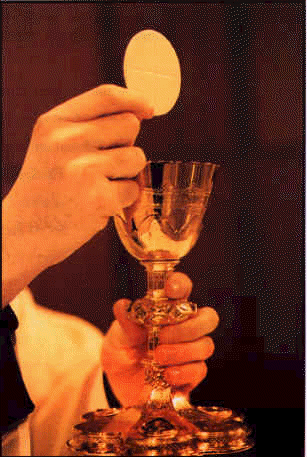
Once again I had the joy and privilege yesterday of being guest on KFUO's "Studio A," hosted by Roland Lettner, this time to discuss Jesus' post-resurrection appearance to His eleven disciples in Matthew 28:16-20. Here's the link to the audio file for the show's first hour. The segment with me begins about half way through.
The first half hour is also well worth a listen. Pr. Dan Torkelson discussed the post-resurrection appearance of Jesus to the Emmaus disciples in Luke 24:13-35.
Random pickings from a Lutheran pastor devoted to the life of Christ in the Body of Christ for the life of the world.
27 April 2011
24 April 2011
Homily for Easter Day
As we celebrated the Resurrection of Our Lord today, I decided to use John Updike's poem "Seven Stanzas at Easter" as the homily's structure for proclaiming the Easter Gospel. In the poem Updike pushes us beyond any sentimental and metaphorical understandings of Jesus' resurrection to give what I've called this homily: an "Easter Reality Check." That is, let's celebrate the very real resurrection of our Lord in the body with all of the reality that implies - even with His molecules reknit and His amino acids rekindled. Updike's poetry here fits quite nicely with our truly human Savior's real resurrection in the body!
Christ is risen! He is risen indeed! Alleluia!
To listen to today's homily for Easter Day, click here and download the audio file.
Christ is risen! He is risen indeed! Alleluia!
To listen to today's homily for Easter Day, click here and download the audio file.
Easter Homily - St. John Chrysostom
St. John Chrysostom lived and preached in the 4th century. He is considered one of the greatest preachers in the history of the Christian Church. His Easter Homily is well known and has been used for many centuries to proclaim the great Good News of our Lord’s Resurrection from the grave.
Is there anyone who is a devout lover of God?
Let them enjoy this beautiful bright festival!
Is there anyone who is a grateful servant?
Let them rejoice and enter into the joy of their Lord!
Are there any weary with fasting?
Let them now receive their wages!
If any have toiled from the first hour,
let them receive their due reward;
If any have come after the third hour,
let him with gratitude join in the Feast!
And he that arrived after the sixth hour,
let him not doubt; for he too shall sustain no loss.
And if any delayed until the ninth hour,
let him not hesitate; but let him come too.
And he who arrived only at the eleventh hour,
let him not be afraid by reason of his delay.
For the Lord is gracious and receives the last even as the first.
He gives rest to him that comes at the eleventh hour,
as well as to him that toiled from the first.
To this one He gives, and upon another He bestows.
He accepts the works as He greets the endeavor.
The deed He honors and the intention He commends.
Let us all enter into the joy of the Lord!
First and last alike receive your reward;
rich and poor, rejoice together!
Sober and slothful, celebrate the day!
You that have kept the fast, and you that have not,
rejoice today for the Table is richly laden!
Feast royally on it, the calf is a fatted one.
Let no one go away hungry. Partake, all, of the cup of faith.
Enjoy all the riches of His goodness!
Let no one grieve at his poverty,
for the universal kingdom has been revealed.
Let no one mourn that he has fallen again and again;
for forgiveness has risen from the grave.
Let no one fear death, for the Death of our Savior has set us free.
He has destroyed it by enduring it.
He destroyed Hades when He descended into it.
He put it into an uproar even as it tasted of His flesh.
Isaiah foretold this when he said,
"You, O Hell, have been troubled by encountering Him below."
Hell was in an uproar because it was done away with.
It was in an uproar because it is mocked.
It was in an uproar, for it is destroyed.
It is in an uproar, for it is annihilated.
It is in an uproar, for it is now made captive.
Hell took a body, and discovered God.
It took earth, and encountered Heaven.
It took what it saw, and was overcome by what it did not see.
O death, where is thy sting?
O Hades, where is thy victory?
Christ is Risen, and you, o death, are annihilated!
Christ is Risen, and the evil ones are cast down!
Christ is Risen, and the angels rejoice!
Christ is Risen, and life is liberated!
Christ is Risen, and the tomb is emptied of its dead;
for Christ having risen from the dead,
is become the first-fruits of those who have fallen asleep.
To Him be Glory and Power forever and ever. Amen!
22 April 2011
Homily for Good Friday
For this year's Good Friday homily we heard from St. Romanos (6th cent.) as he proclaims the meaning of Christ's crucifixion by means of a conversation between Hell and Satan. (Okay, the voice is mine, but the words are those of Romanos.) As they witness that a thief, of all people, can be welcomed again to paradise, they realize that the Cross is not so barren after all, but actually bears the fruit of life - and their plans are thwarted. I gave this homily the title "Again to Paradise" based on the line repeated through the dialogue.
Click on this link, download the audio file, and hear the poetic proclamation of our crucified Lord bringing all of us "Again to Paradise."
21 April 2011
Homily for Holy Thursday
Tonight's homily, "Meal of Divine Love," sought to weave together our Lord's institution of the Eucharist with His command to "love one another." As we are fed by our Lord's Meal of love, receiving His forgiveness, life, and salvation, we are strengthened to love one another as our Lord has loved us.
To listen, click here and download the audio file.
Holy Thursday's Joy!
The happy commemoration of today's feast with its immense concourse of people invites us to prolong fervently our praises of the Most Holy Body of Christ. What could be sweeter, what more pleasing to the heart of the faithful than to exalt the abyss of his divine charity, and to glorify the overflowing torrent of his love! At the table of the new grace the hand of the priest distributes ceaselessly his Flesh as food and his precious Blood as drink, to those who are his children and heirs of the kingdom promised by God to those who love him.
O endless Emanation of the goodness of God and of his immense love for us, admirable and worthy of all praise! In this sacrament, where all former sacrifices are done away with, he remains with us to the end of the world; he feeds the children of adoption with the bread of angels and inebriates them with filial love.
(Thomas Aquinas, Lectionary and Martyrology, ed. Encalcat 1956, 288; as cited in J. Robert Wright, Readings for the Daily Office from the Early Church, 171.)
19 April 2011
Video Catechesis on Confession
"Our churches teach that private Absolution should be retained in the churches, although listing all sins is not necessary for Confession. For, according to the Psalm, it is impossible. 'Who can discern his errors?' (Psalm 19:12)." (Augsburg Confession, XI)
"...the Power of the Keys administers and presents the Gospel through Absolution, which is the true voice of the Gospel." (Apology of the Augsburg, XII:39)
"So we teach what a splendid, precious, and comforting thing Confession is.... If you were a Christian, then you ought to be happy to run more than a hundred miles to Confession and not let yourself be urged to come. You should rather come and compel us [pastors] to give you the opportunity.... When I urge you to go to Confession, I am doing nothing else than urging you to be a Christian." (Martin Luther, Large Catechism, Exhortation to Confession, 26, 28, 30, 32)
Or, to teach it visually:
17 April 2011
Homily for Palm/Passion Sunday
Today began with Jesus' procession into Jerusalem as the crowd sang, "Blessed is He who comes in the name of the Lord." Then it quickly moved to and ended with the King taking His throne on the cross, wearing a crown of thorns and covered in His own blood - blood that He sheds to cleanse and make us holy. Thus, we have the Palm Sunday-Passion Sunday tension. The homily focused on Jesus' Passion and Crucifixion as told in St. Matthew 27:11-54. Resisting the temptation to settle for a mere, literal three word sermon - "For you! Amen!" - the homily seeks to bring out the "Great Exchange," that is, how Jesus, in His suffering and dying, is "Trading Places" with us to bring us back to peace with God.
To listen to today's Passion Sunday homily, click here and download the audio file.
Oh, and the Cranach altarpiece referred to at the beginning of the homily is the one shown here.
16 April 2011
The Cross
Here's gem from St. John Chrysostom as we enter Holy Week and ponder the Cross of our Lord Jesus Christ and what it means for all of us:
The cross used to denote punishment but it has now become a focus of glory. It was formerly a symbol of condemnation but it is now seen as a principle of salvation. For it has now become the source of innumerable blessings: it has delivered us from error, enlightened our darkness, and reconciled us to God; we had become God's enemies and were foreigners afar off, and it has given us his friendship and brought us close to him. For us it has become the destruction of enmity, the token of peace, the treasury of a thousand blessings.
Thanks to the cross we are no longer wandering in the wilderness, because we know the right road; we are no longer outside the royal palace, because we have found the way in; we are not afraid of the devil's fiery darts, because we have discovered the fountain. Thanks to the cross we are no longer in a state of widowhood, for we are reunited to the Bridegroom; we are not afraid of the wolf, because we have the good shepherd: "I am the good shepherd," he said. Thanks to the cross we dread no usurper, since we are sitting beside the King.
That is why we keep festival as we celebrate the memory of the cross. St. Paul himself invites us to this festival in honor of the cross: "Let us celebrate the feast not with the old leaven, that of corruption and wickedness, but with the unleavened bread of sincerity and truth." And he tells us why, saying, "Christ, our Passover, has been sacrificed."
Now do you see why he appoints a festival in honor of the cross? It is because Christ was immolated on the cross. And where he was sacrificed, there is found abolition of sins and reconciliation with the Lord; and there, too, festivity and happiness are found: "Christ, our Passover, has been sacrificed."
Where was he sacrificed? On a gibbet. The altar of this sacrifice is a new one because the sacrifice himself is new and extraordinary. For he is at one and the same time both victim and priest; victim according to the flesh and priest according to the spirit.
This sacrifice was offered outside the camp to teach us that it is a universal sacrifice, for the offering was made for the whole world; and to teach us that it effected a general purification and not just that of the Jews. God commanded the Jews to leave the rest of the world and to offer their prayers and sacrifices in one particular place; because all the rest of the world was soiled by the smoke and smell of all the impurities of pagan sacrifices. But for us, since Christ has now come and purified the whole world, every place has become an oratory.
(St. John Chrysostom, Homily 1 on the Cross and the Thief 1: PG 49, 399-401; as cited in J. Robert Wright, Readings for the Daily Office from the Early Church, 163-164)
Subscribe to:
Posts (Atom)