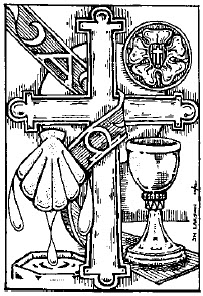
Twenty-one years ago today, the Church ordained a young, twenty-six year old man into the Office of the Holy Ministry ... and the Lord has been having His way ever since. That young pastor was going to take the Church by storm and help all kinds of people by proclaiming the Gospel of Jesus Christ and administering His Sacraments.
However, as I recall hearing at one weekly, after-chapel symposium during seminary, "people don't want your help." And, as the Lord has been stressing for these past twenty-one years, He wants to keep and tend His Church in His own ways. I hold neither bitterness nor regret over this. That's how it should be for all pastors in Christ's one, holy, catholic and apostolic Church. After all, serving the Lord in His Church is not a right to be pushed, but a gift, a privilege and an honor, all to be received with humility and thanksgiving.
You see, ordination is about being put "under orders" to be the Lord's man--not my own--and to carry out the Lord's bidding--again, not my own.
We usually mark anniversaries on the tens or fives--10, 20, 25, 30, 50, etc.--and last year's 20th anniversary was marked with the rite of "Anniversary of an Ordination" followed by a dinner replete with appreciative congregants, brother pastors, kind words, and treasured gifts. One of those brother pastors (you know who you are, TW) was even present, lo, those twenty-one years ago today. Not only am I honored he was there back then; I'm also honored to call him friend and brother in Office still to this day.
But what to do with a "21st" anniversary? Instead of letting the seeming oddity of the number, or the anticlimax after last year, overshadow, it strikes me that this is perhaps a more perfect number to remember the joys of ordination. After all, 21 is nothing other than the product of two Biblical numbers of completion: 7 x 3. So, sans anniversary rites and honored guests, today gives the opportunity to reflect on what being "under orders" in Christ's holy Church truly means.
Some Scripture passages come to mind. They have often guided, comforted, and returned me to the "core values" for the Office throughout these 7 x 3 years:
Acts 20:28 - "Pay careful attention to yourselves and to all the flock, in which the Holy Spirit has made you overseers, to care for the church of God,which he obtained with his own blood."
This is how one should regard us, as servants of Christ and stewards of the mysteries of God. Moreover, it is required of stewards that they be found faithful."
1 Corinthians 9:16-17 - "For if I preach the gospel, that gives me no ground for boasting. For necessity is laid upon me. Woe to me if I do not preach the gospel! For if I do this of my own will, I have a reward, but if not of my own will, I am still entrusted with a stewardship."
1 Timothy 4:16 - "Keep a close watch on yourself and on the teaching. Persist in this, for by so doing you will save both yourself and your hearers."
2 Timothy 4:1-2 - "I charge you in the presence of God and of Christ Jesus, who is to judge the living and the dead, and by his appearing and his kingdom: preach the word; be ready in season and out of season; reprove, rebuke, and exhort, with complete patience and teaching."
1 Peter 5:2-4 - "Shepherd the flock of God that is among you, exercising oversight,not under compulsion, but willingly, as God would have you;not for shameful gain, but eagerly; not domineering over those in your charge, but being examples to the flock. And when the chief Shepherd appears, you will receive the unfading crown of glory."
Of course, Article V from the Augsburg Confession has also been a concise, pithy, and oft-needed reminder of the purpose of the Office of the Holy Ministry and Who really works through it:
 So that we may obtain this faith, the ministry of teaching the Gospel and administering the Sacraments was instituted. Through the Word and Sacraments, as through instruments, the Holy Spirit is given. He works faith, when and where it pleases God, in those who hear the good news that God justifies those who believe that they are received into grace for Christ's sake. (Concordia, p. 33)
In none of these passages do I find a hint of being successful, or being the man of the hour, or ascending the levels of acclaim, even in ecclesiastical guise. No, we pastors are but stewards--mere mid-level managers, humble table-waiters--for Someone else, namely, our Lord Jesus Christ. In Advent we are reminded of John the Baptist, Forerunner of the Christ. May his memorable words become the operating principle of every trustworthy steward:
"He [Christ] must increase, but I must decrease." (John 3:30)
Other pearls of wisdom that have guided, comforted, and kept me on track these past two decades come from various sources. Dietrich Bonhoeffer had a way of making such pearls stick when he wrote of "visionary dreaming." He speaks in general terms, but his words apply, I think, especially well to us pastors:
God hates visionary dreaming; it makes the dreamer proud and
pretentious. The man who fashions a visionary ideal of community demands
that it be realized by God, by others, and by himself. He enters the
community of Christians with his demands, sets up his own law, and
judges the brethren and God Himself accordingly. He stands adamant, a
living reproach to all others in the circle of brethren. He acts as if
he is the creator of the Christian community, as if his dream binds men
together. When things do not go his way, he calls the effort a failure.
When his ideal picture is destroyed, he sees the community going to
smash. So he becomes, first an accuser of his brethren, then an accuser
of God, and finally the despairing accuser of himself.
Because God has already laid the only foundation of our fellowship,
because God has bound us together in one body with other Christians in
Jesus Christ, long before we entered into common life with them, we
enter into that common life not as demanders but as thankful recipients.
We thank God for what He has done for us. We thank God for giving us
brethren who live by His call, by His forgiveness, and His promise. We
do not complain of what God does not give us; we rather thank God for
what He does give us daily. And is not what has been given us enough:
brothers, who will go on living with us through sin and need under the
blessing of His grace? Is the divine gift of Christian fellowship
anything less than this, any day, even the most difficult and
distressing day? Even when sin and misunderstanding burden the communal
life, is not the sinning brother still a brother, with whom I, too,
stand under the Word of Christ? Will not his sin be a constant occasion
for me to give thanks that both of us may live in the forgiving love of
God in Jesus Christ? Thus the very hour of disillusionment with my
brother becomes incomparably salutary, because it so thoroughly teaches
me that neither of us can ever live by our own words or deeds, but only
by that one Word and Deed which binds us together—the forgiveness of
sins in Jesus Christ. When the morning mists of dreams vanish, then
dawns the bright day of Christian fellowship. (Life Together, 27-29)
One of many pearls from Eugene Peterson comes when he critiques pastors in America for being "shopkeepers":
The pastors of America have metamorphosed into a company of shopkeepers, and the shops they keep are churches. They are preoccupied with shopkeeper's concerns--how to keep the customers happy, how to lure customers away from competitors down the street, how to package the goods so that the customers will lay out more money. (Working the Angles, 2)
Peterson then goes on to give the proper corrective to this modern problem:
The biblical fact is that there are no successful churches. There are, instead, communities of sinners, gathered before God week after week in towns and villages all over the world. The Holy Spirit gathers them and does his work in them. In these communities of sinners, one of the sinners is called pastor and given a designated responsibility in the community. The pastor's responsibility is to keep the community attentive to God. (Working the Angles, 2)

Evelyn Underhill offers a priceless pearl of wisdom for pastors seeking to be faithful to Jesus their true Shepherd. Instead of calling pastors "undershepherds," she refers to them as "sheepdogs." Sheepdogs have become my favorite image for my God-given vocation, because, as Underhill observed on her way to her talk with Sunday School teachers:
They were helping the shepherd to deal with a lot
of very active sheep and lambs, to persuade them into the right
pastures, to keep them from rushing down the wrong paths. And how did
the successful dog do it? Not by barking, fuss, ostentatious authority,
any kind of busy behaviour. The best dog that I saw never barked once;
and he spent an astonishing amount of his time sitting perfectly still,
looking at the shepherd. The communion of spirit between them was
perfect. They worked as a unit. Neither of them seemed anxious or in a
hurry. Neither was committed to a rigid plan; they were always content
to wait. That dog was the docile and faithful agent of another mind. He
used his whole intelligence and initiative, but always in obedience to
his master’s directive will; and was ever prompt at self-effacement. The
little mountain sheep he had to deal with were amazingly tiresome, as
expert in doubling and twisting and going the wrong way as any naughty
little boy. The dog went steadily on with it; and his tail never ceased
to wag.
What did that mean? It meant that his relation to the shepherd was
the centre of his life; and because of that, he enjoyed doing his job
with the sheep, he did not bother about the trouble, nor get discouraged
with the apparent results. The dog had transcended mere dogginess. His
actions were dictated by something right beyond himself. He was the
agent of the shepherd, working for a scheme which was not his own and
the whole of which he could not grasp; and it was just that which was
the source of the delightedness, the eagerness, and also the discipline
with which he worked. But he would not have kept that peculiar and
intimate relation unless he had sat down and looked at the shepherd a
great deal. (Evelyn Underhill, “The Teacher’s Vocation,” Collected Papers of Evelyn Underhill, Lucy Menzies, ed. (New York: Longmans, Green and Co., Inc., 1946), pp. 182-183.)
One of last year's treasured gifts is a small figurine sheepdog that sits here on my desk in the church study. It happens to be turning its head and looking backward to its right. In that direction on my study wall hangs a framed version of this passage from Underhill. I've titled it "Pastors as Sheepdogs" and included a picture of another sheepdog as well as an icon of Jesus the Good Shepherd. It truly is amazing how such visual reminders can keep us pastors anchored in our proper identity and work.

A final pearl comes from C. F. W. Walther, 19th century pastor, professor, and president of the Missouri Synod. Upon re-reading his
Law and Gospel recently, he again reminds me - and all pastors - of what really happens in our day to day service and tasks.
It is a glorious and marvelous arrangement--one that surpasses all
understanding--that God governs the kingdoms of this world, not by
immediate action but through the agency of human beings who, in addition
to all their other shortcomings, are far too short-sighted and far too
feeble for this task. As such, it is all the more marvelous that even in
His kingdom of grace, God plants, manages, extends, and sustains His
kingdom not directly, but by means of men who are altogether unfit for
this task. This is proof of God's loving-kindness, love for humanity,
and wisdom, which no human intellect can understand. For who can measure
the greatness of God's love, revealed in the fact that He desires not
only to save this apostate world but also even to employ human
beings--that is, sinners--for this task? Who can plumb the depths of the
wisdom of God, who knows how to accomplish the work of saving people
by--of all things--using other people who are quite unfit and
unqualified for this work? And who can understand that He has previously
gloriously pursued, and still is pursuing, this work? (Law and Gospel: How to Read and Apply the Bible, 42)
Thank You, heavenly Father, for Your wisdom and loving-kindness in using me, of all people, to proclaim Your saving words and works for twenty-one years. Thank You, Lord Jesus Christ, for suffering, dying, and rising again to redeem me, a lost and condemned person, and then honoring me with the lifelong task of dispensing Your gifts to Your flock. Thank You, Holy Spirit, for sustaining me in the faith, working through me in spite of my weaknesses and shortcomings (and plain old blunders), and granting the comfort and peace of Your life.
"Now to him who is able to do far more abundantly than all that we ask or think, according to the power at work within us, to him be glory in the church and in Christ Jesus throughout all generations, forever and ever. Amen." (Ephesians 3:20-21)


 Twenty-one years ago today, the Church ordained a young, twenty-six year old man into the Office of the Holy Ministry ... and the Lord has been having His way ever since. That young pastor was going to take the Church by storm and help all kinds of people by proclaiming the Gospel of Jesus Christ and administering His Sacraments.
 Evelyn Underhill offers a priceless pearl of wisdom for pastors seeking to be faithful to Jesus their true Shepherd. Instead of calling pastors "undershepherds," she refers to them as "sheepdogs." Sheepdogs have become my favorite image for my God-given vocation, because, as Underhill observed on her way to her talk with Sunday School teachers:
 A final pearl comes from C. F. W. Walther, 19th century pastor, professor, and president of the Missouri Synod. Upon re-reading his Law and Gospel recently, he again reminds me - and all pastors - of what really happens in our day to day service and tasks.


